Clinical & Life Sciences Pathway
Future aspiration:
Medicine, Dentistry, Veterinary Science or related Life Sciences degrees.
Students following the Clinical & Life Sciences Pathway typically study A Level subjects such as Biology and Chemistry, often alongside Mathematics or Psychology, to build the scientific knowledge required for clinical and biomedical study. Their portfolios focus on demonstrating ethical reasoning, reflective thinking, communication skills and sustained commitment to healthcare-related interests, alongside admissions test and interview preparation where required.
Electives such as Clinical Thinkers provide insight into medical, dental and veterinary practice, while UCAT preparation supports students developing aptitude for admissions assessments. Mic Drop (Public Speaking) strengthens communication skills essential for interviews and patient-centred professions, allowing students to articulate ideas clearly and confidently.
Physical & Applied Sciences Pathway
Future aspiration:
Chemistry or related physical science degrees.
Students on the Physical & Applied Sciences Pathway typically combine A Level subjects such as Chemistry, Mathematics, Further Mathematics and Physics, building a strong theoretical foundation for demanding scientific study. Alongside their academic programme, students develop a strategic portfolio that evidences problem-solving ability, logical reasoning and sustained subject engagement, including preparation for admissions tests where required.
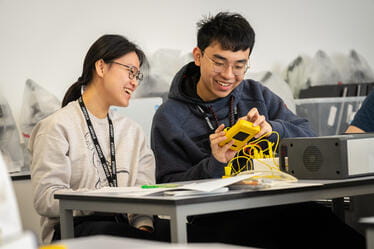
Supercurricular electives play a central role in strengthening this pathway. Brain STEM offers advanced exploration of scientific and engineering concepts, while Mathematics Olympiad Preparation develops competitive problem-solving and mathematical resilience. Through Robotics & Electronics, students apply physical principles in practical contexts, gaining hands-on experience that demonstrates analytical thinking beyond the classroom. Together, these experiences support applications to the most competitive universities by providing clear evidence of intellectual curiosity, academic depth and readiness for rigorous scientific study.
Social & Commerce Sciences Pathway
Future aspiration:
Economics, Business, Law, Politics or Social Sciences.
Students on the Social & Commerce Sciences Pathway often combine A Level subjects such as Economics, History, Politics and Mathematics, developing strong analytical, evaluative and written communication skills. Portfolios emphasise critical thinking, structured argument and engagement with real-world economic, legal and political issues, all of which are highly valued by competitive universities.
Supercurricular electives including History & Politics, Risk & Return, Marketing & Branding Lab and preparation support students in applying theory to contemporary contexts. Through these activities, students build evidence of independent thought, intellectual curiosity and academic maturity.
Computational & Data Sciences Pathway
Future aspiration:
Computer Science, Data Science, Artificial Intelligence or Technology.
Students pursuing the Computational & Data Sciences Pathway typically study A Level subjects such as Mathematics, Further Mathematics, Computer Science and Physics, developing the logical and technical foundations required for computational study. Their portfolios focus on coding ability, algorithmic thinking, data analysis and problem-solving, alongside evidence of independent project work.
Electives such as Robotics & Electronics, Computer Simulation, Brain STEM and Number Puzzles allow students to apply computational thinking in practical and interdisciplinary contexts. These experiences help students demonstrate readiness for highly technical degree programmes and the rapidly evolving demands of technology-driven fields.
Building Strong Academic Portfolios Through Supercurricular Engagement
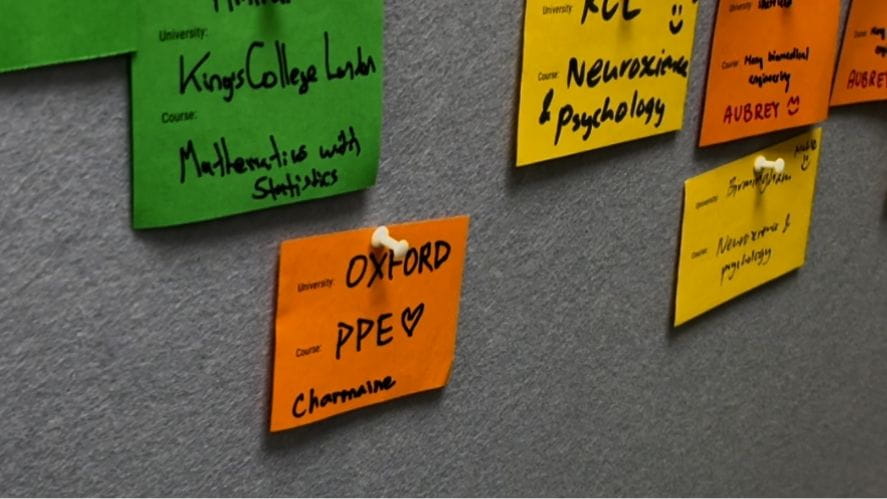
Across all Global Strategic Pathways, supercurricular electives play a crucial role in building credible, evidence-rich academic portfolios. Through research-led activities, extended problem-solving, academic writing and independent enquiry, students are able to demonstrate genuine subject engagement beyond the classroom. In several cases, this depth of exploration has led to outstanding outcomes, including three OIC students having their work published in academic papers. These achievements reflect the intellectual curiosity, rigour and confidence that electives are designed to foster, and provide powerful evidence of readiness for highly competitive university study.


.png?h=499&iar=0&w=887&rev=a0d209a8d1ba479d80ec2aad2e282a61&hash=94DF9005189FDBD0460D026119E65EA1)

.png?rev=6dacc97622184f3793d82e652b870b3d&hash=DEC1D998CA6101A3A640465AFB7701FE)
.png?rev=660a03c0722c4fd3bb92c2b6179c0eee&hash=6A855A052199D907229E1DE1E6AAEC84)
.png?rev=586f44e66e7048b6952feb066c93ef0e&hash=72E6F1337A83702E8AA6E3DB31414275)
.png?rev=040df6039a4d4575b312eef1fec996cc&hash=097BC3302807FDA6E5D467792EEBF5FF)
.png?h=499&iar=0&w=887&rev=11d8a833970749b1baa0d9f862e5aa81&hash=644C2D3B5B4D006C69DB4242C638EA42)
.png?h=499&iar=0&w=887&rev=41f03591bea54f60826a3778194a19b5&hash=05E7EB3FE6FA54612F08D28B130C44E0)