

22 June, 2026
Chemistry in Action
.png?h=499&iar=0&w=887&rev=3ed6dacbac284a55ad95e08425327804&hash=43DEA7EAF493042E1ACD92BB3105710B)
Our A Level Chemistry students recently stepped into the role of research chemists as they successfully synthesised aspirin, one of the world's most widely used medicines, through a challenging practical investigation.
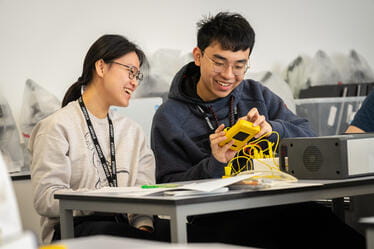
The experiment provided students with the opportunity to apply their understanding of organic chemistry in a real laboratory setting, combining theoretical knowledge with the practical techniques used by scientists in universities, pharmaceutical laboratories and industry.
Beginning with 2-hydroxybenzoic acid (salicylic acid) and ethanoic anhydride, students carried out an organic synthesis reaction to produce aspirin (acetylsalicylic acid). Throughout the practical, they carefully controlled reaction conditions, measured reagents with precision and heated the mixture under reflux to maximise the efficiency of the reaction.
Once the synthesis was complete, students purified their product using recrystallisation, an essential technique that removes impurities and improves the quality of the final compound. They then filtered and dried their crystals before carrying out one of the most important analytical tests in organic chemistry: determining the melting point of their aspirin.
Melting point analysis is widely used by chemists to assess the purity of a substance. A pure compound melts over a narrow temperature range, allowing students to compare their results with published values and evaluate the success of their synthesis.
The investigation brought together a broad range of advanced laboratory skills, including:
•Accurate weighing and measurement of chemical reagents
•Organic synthesis techniques
•Heating under reflux
•Vacuum filtration
•Recrystallisation
•Product purification
•Melting point determination and analytical testing
These are the same fundamental techniques used across chemical research, pharmaceutical development and industrial laboratories, giving students valuable experience beyond the A Level specification while reinforcing the practical skills required for higher education.
Practical investigations such as this play a vital role in developing scientific thinking. Students must plan carefully, work safely, interpret experimental data and evaluate the reliability of their results—skills that are essential for success in chemistry and a wide range of STEM disciplines.
By experiencing chemistry in action, our students gain a deeper appreciation of how scientific discoveries are translated into everyday applications, while building the confidence and technical expertise needed for future study and careers in science, medicine and engineering.
Beginning with 2-hydroxybenzoic acid (salicylic acid) and ethanoic anhydride, students carried out an organic synthesis reaction to produce aspirin (acetylsalicylic acid). Throughout the practical, they carefully controlled reaction conditions, measured reagents with precision and heated the mixture under reflux to maximise the efficiency of the reaction.
Once the synthesis was complete, students purified their product using recrystallisation, an essential technique that removes impurities and improves the quality of the final compound. They then filtered and dried their crystals before carrying out one of the most important analytical tests in organic chemistry: determining the melting point of their aspirin.
Melting point analysis is widely used by chemists to assess the purity of a substance. A pure compound melts over a narrow temperature range, allowing students to compare their results with published values and evaluate the success of their synthesis.
The investigation brought together a broad range of advanced laboratory skills, including:
•Accurate weighing and measurement of chemical reagents
•Organic synthesis techniques
•Heating under reflux
•Vacuum filtration
•Recrystallisation
•Product purification
•Melting point determination and analytical testing
These are the same fundamental techniques used across chemical research, pharmaceutical development and industrial laboratories, giving students valuable experience beyond the A Level specification while reinforcing the practical skills required for higher education.
Practical investigations such as this play a vital role in developing scientific thinking. Students must plan carefully, work safely, interpret experimental data and evaluate the reliability of their results—skills that are essential for success in chemistry and a wide range of STEM disciplines.
By experiencing chemistry in action, our students gain a deeper appreciation of how scientific discoveries are translated into everyday applications, while building the confidence and technical expertise needed for future study and careers in science, medicine and engineering.
Related news
News image ![Boarding Beyond the Classroom - 18 September 2026 - Boarding This week]() News
News
 News
News Boarding Beyond the Classroom
Oxford International College students enjoyed netball and air-dry clay making as part of the weekly boarding programme, combining sport, creativity, friendship and time to unwind.
News image ![Shortlisted for the John Locke Essay Prize - Shortlisted for the John Locke Essay Prize]() News
News
 News
News Shortlisted for the John Locke Essay Prize
An OIC student has been shortlisted for the 2026 John Locke Institute Global Essay Prize in Psychology, recognising exceptional academic writing, critical thinking and independent research.