

Key Takeaways: AI and Student Feedback
AI can help teachers identify misconceptions and patterns in student work.
Teacher expertise must remain central to interpreting student intent.
Different A Level subjects require different approaches to AI-assisted feedback.
Department Heads determine where AI supports learning without compromising academic integrity.
At Oxford International College, AI is used to amplify expert teaching, not replace it.

13 March, 2026
Enhancing Student Feedback While Preserving Teacher Expertise
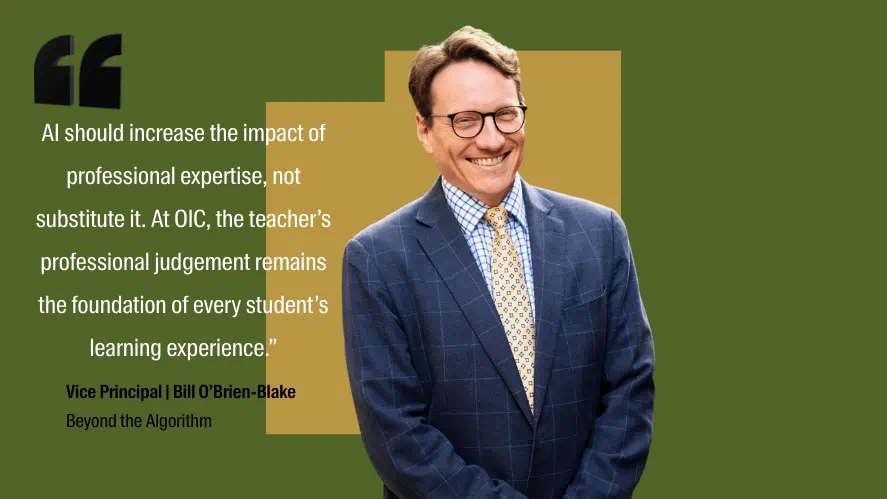

“AI should increase the impact of professional expertise, not substitute it. At Oxford International College, the teacher’s professional judgement remains the foundation of every student’s learning experience.”
At OIC, as is true of many educational institutions, we continue to grapple with the opportunities and challenges presented by AI across a range of college functions. One area of considerable focus for our AI working group has been the possible ways in which AIaugmented feedback could save teachers’ time and improve the quality of feedback students receive. This is a live issue across the sector, and indeed Ofqual’s 2026 guidance has opened the door to appropriate and justifiable use of AI tools in this manner.
Our College makes use of highly regular exam-style assessments, and our midterm reviews fall in the middle of each term, with feedback delivered as students progress through specifications and classroom teaching, with further assessments shortly to follow. These are the assessments in which we will explore how AI can responsibly augment our feedback processes, as they carry significant diagnostic weight at a point where targeted, actionable responses can meaningfully shape student progress over the remainder of the term.
Protecting Academic Integrity When Using AI in Schools
The threats here are profound, however. Integrity, quality, and professional control come under question when we delegate aspects of the teacher’s role to tools we do not own or control, and may not fundamentally understand. At OIC we started from the core position that AI tools can only be useful when strictly framed by pedagogical experts, and so the process starts with the teacher.
Because feedback is helpful only when it is oriented toward a student’s specific intentions—what they meant to do compared with what they actually did—any proposed feedback needs teacher oversight in order to have value for the student. Additionally, if used thoughtlessly, AI could deskill teachers by shifting too much interpretive work to automated systems, leaving teachers to validate rather than evaluate. This is precisely the risk we intend to avoid.
Why AI Cannot Be Applied the Same Way Across Every A Level Subject
A further challenge, particularly relevant in our context, arises from the fundamentally different assessment practices across A Level subjects. Each subject demands different methods, judgments, criteria, and forms of interpretation, and any AI steps that seek a generalised approach that ignores this will inevitably weaken the validity of feedback rather than strengthen it.
At OIC our feedback is deliberately subjectowned, because what counts as good work in Mathematics, Economics, Chemistry or English Literature is fundamentally different. In quantitative subjects, feedback often hinges on identifying misconceptions, procedural errors, or missing steps in reasoning, advising students on their misused heuristic or misapplied method. In contrast, essaybased subjects require nuanced interpretation of argument, tone, structure, and conceptual originality—areas in which no current AI system can reliably evaluate intent or quality. In these disciplines, AI has a much narrower, more cautious role, aligned to teacherdefined rubrics and strictly limited to supportive functions.
A Teacher-Led Approach to AI in Education
As such, we have the capacity to fully engage with what AI can do to expand the range of feedback we provide and enhance its quality and consistency, while at all times ensuring that professional expertise and thorough understanding of our students is the foundation of this AI action.
We have identified particular forms of feedback where AI can contribute without compromising quality or validity. This includes defined summary comments from teachersourced rubrics, rapid identification of common misconceptions in student work, and personalised next steps defined explicitly by weaknesses in assessed work. By considering AI’s role with a clear view of distinct subject epistemologies, we avoid the mistake of applying one tool indiscriminately across all disciplines. This is a strength of our model. Our Department Heads determine where AI fits and where it does not. This protects the integrity of assessment while still allowing innovation where it is genuinely appropriate.
Using AI to Support High-Quality Student Feedback
Our approach is designed to strengthen teacher expertise. Teachers remain the arbiters of correctness, quality, interpretation, and next steps. AI does not generate the underlying judgement; it only assists with the labourintensive or mechanical elements surrounding that judgement.
We require staff to scrutinise AI outputs critically—to reject them where necessary, adapt them where appropriate, and ensure they remain anchored to the pedagogical purpose of the task. This means that rather than reducing the intellectual work of teaching, AI can increase the time available for it.
Teachers are freed from repetitive commentwriting and patternspotting, but they remain fully responsible for diagnosing misconceptions, understanding student intentions, shaping the learning trajectory, and deciding precisely what feedback will improve performance.
In this way, AI becomes a tool for professional amplification, not professional erosion. It adds capacity without replacing judgement, and it helps teachers operate at a higher level of precision, not a lower one.
How AI Can Improve Learning Outcomes for Students
Students receive thorough, detailed feedback grounded in the professional expertise of our teachers, while teachers find that some of the most timeconsuming but necessary features of feedback—the tailored and specific commentary on errors and misconceptions—are quickly actionable and understandable. Our forthcoming engagement with AI will then enable us to ensure that every student receives highly targeted guidance about what to do next, why it matters, and which specific actions will lead to improvement, as if their teachers had even greater time to do this. Teachers can then devote more of their time to the expert teaching in class that brings about improvements in student performance.
The Future of AI in Education at Oxford International College
Our work in this area will continue to evolve as the technology and evidence base develop. What will not change is our central principle: at OIC, AI is used effectively not to replace expert teaching, but to augment it and help multiply its impact, enhance its accuracy, and compound its contribution to learning.
About the Author
Bill — Vice Principal, Oxford International College
Bill leads academic strategy and teaching innovation at Oxford International College in Oxford, one of the UK’s highest-performing sixth form colleges. His work focuses on maintaining academic excellence while exploring how emerging technologies can responsibly support teaching, assessment, and student learning.
Related Articles
How UK Schools Protect Students in a Digital World
Building Tech-Ready Values-Led Global Citizens
Related news
News image ![Human First, Future Ready: AI in Education | Oxford International College - AI In Education]() Blog
Blog
/beyond-the-algorithm-(2).png?h=499&iar=0&w=887&rev=1c3f1c7d2f01434e8cb5730f20cd43b4&hash=3B9EA9E27A2B3D6423671571F9495BCB) Blog
Blog Human First, Future Ready | AI in Education
Human First, Future Ready explores how Oxford International College approaches AI in education with purpose, integrity and a strong focus on wellbeing, safeguarding and academic excellence.
News image ![Building Tech-Ready Values-Led Global Citizens - Building Tech-Ready Values-Led Global Citizens]() Blog
Blog
.png?h=499&iar=0&w=887&rev=162ca7602d6b418c8d22a075750cb0d9&hash=4B1E5A5D7AE0DFE031C946C0BEEC1D3B) Blog
Blog Building Tech-Ready Values-Led Global Citizens
In a world shaped by constant connectivity and artificial intelligence, students need more than academic knowledge. Boarding provides a community where young people learn independence, digital discipline and the human skills that technology cannot replace.
.png?h=499&iar=0&w=887&rev=fa817aa6c7c248b8aa9974571fd5e4f4&hash=97FBE1CF1622E0AF4D0777237F160095)